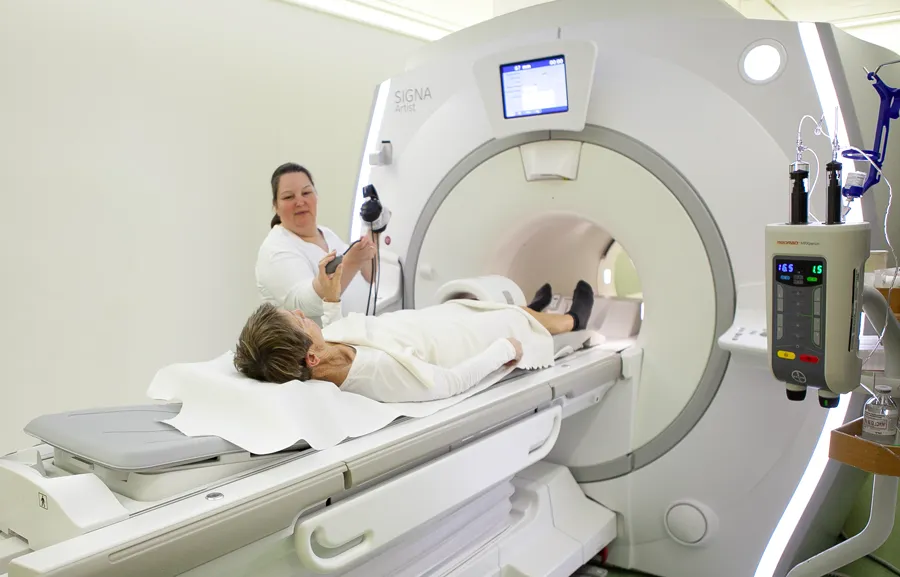
In most cities, the letters MRT point to trains. They conjure images of platforms, timetables, and the hum of electric motors beneath a crowded city. But in Wolfsburg, those three letters belong first to a machine that sees inside the human body. Magnetresonanztomographie, magnetic resonance imaging, is the MRT that residents here encounter in daily life. It is a diagnostic tool housed in clinics near the Hauptbahnhof, drawing patients from Gifhorn Privat MRT , Braunschweig, Helmstedt, and beyond. It is a modern, radiation-free technology for examining brains, spines, joints, and organs. Its presence in Wolfsburg is unremarkable precisely because it is so ordinary. That ordinariness tells its own story about the city.
For a place built on the automobile, Wolfsburg’s relationship with rail is surprisingly deep. The city grew around the Volkswagen factory in the late 1930s, and the railway lines that fed the plant became its arteries. Today, the Hauptbahnhof anchors a regional network connecting Wolfsburg to Braunschweig, Hannover, and Berlin. The Wolfsburger Verkehrsbetriebe runs roughly one hundred buses across twenty-two routes, moving nearly forty thousand people daily. Yet the most heated transport debates in recent years have not been about buses or cars but about something that does not exist: a tram.
The idea of a Stadtbahn, or urban light rail, for Wolfsburg has been proposed, studied, and shelved more times than anyone can count. A feasibility study recommended abandoning tram plans in favor of a quality bus system, arguing that the cost-benefit ratio favored rubber tires over steel wheels. The city council followed that recommendation, and the tram remained a dream. But the dream did not die. A citizens’ group called Amsel 44 has continued to hang tram stop signs along a proposed route from Nordfriedhof to Detmerode, insisting that the city’s broad streets and dense north-south corridors make light rail both feasible and necessary. Their argument is simple: buses, no matter how comfortable, cannot match the capacity, efficiency, or passenger appeal of a modern tram.
What makes this debate more than a local squabble is the way it mirrors Wolfsburg’s identity crisis. The city was born from the automobile, and for decades its planning logic followed the car. Wide roads, ample parking, and a dispersed layout made driving effortless. But that same car-centric design has made efficient public transit harder to achieve. Statistics show that 89 percent of trips over ten kilometers in Wolfsburg are made by car, while public transport captures a fraction of that. The Berliner Brücke, a critical northern crossing over the Mittellandkanal, is now structurally compromised, with weight restrictions imposed since 2022. When it is rebuilt, activists argue, tracks should be laid directly into the new structure, not added later as an afterthought. Their slogan is blunt: the most beautiful quality bus does not replace a modern tram, neither ecologically, nor in sustainability, nor in passenger benefit, nor economically.
The counterargument is equally pragmatic. Wolfsburg is not a metropolis. Its population is modest, and its bus network already covers the city reasonably well. A tram would require enormous upfront investment, dedicated maintenance facilities, and political will that has repeatedly evaporated. The city council has instead committed to a long-term contract with the WVG, enabling investment in electric buses and a new depot, a steady, unglamorous approach to public transport that avoids the risks of a megaproject. For many residents, that is enough.
Yet the deeper question remains unresolved. What is Wolfsburg for? Is it a company town that happens to have residents, or a real city that happens to host a car manufacturer? The Autostadt, Volkswagen’s gleaming theme park and delivery center, draws millions of visitors and serves as the city’s de facto living room. But the Autostadt is a destination, not a neighborhood. The people who live in Westhagen and Detmerode, who commute to the factory or to Braunschweig, need something different. They need to get to work on time, in comfort, without owning a car they cannot afford.
The MRT that Wolfsburg actually has, the medical imaging machine, serves a real need, diagnosing illness and saving lives without the drama of infrastructure politics. Perhaps that is the lesson. The city’s future may not be decided by grand gestures or gleaming trams, but by the quiet accumulation of small improvements: a bus that comes more often, a stop with a bench and a roof, a connection that works. The letters MRT will keep meaning what they mean to the people who need them, whether they are patients seeking a scan or commuters dreaming of a train that never comes. Wolfsburg, a city built on four wheels, remains unsure whether it wants to move on rails.